“The old home, especially during the first years, was frequently visited by Indians, who gradually withdrew as the white settlers advanced, but as they had been fairly and honestly dealt with the noble William Penn, they never molested the white settlers of the lower part of Pennsylvania… A few depredations by white men committed against the Indians were promptly punished by the government. The Indians did the same thing with their bad men, so a general good feeling prevailed, until the beginning of the French and Indian War in 1754.”
‘Descendants of Jacob Hostetler, the Immigrant of 1736, Part I” pg. 26
This part of the Baker ancestral tale is usually called “The Hochstetler Massacre”, which is correct, in that the Jacob Hochstetler Family was attacked one night, surrounded by Indians, house set on fire. Two of Hochstetler children were killed, the Mother was scalped and killed, the Father and two young sons were all taken into captivity into three separate communities. Yet, the Lenape Indians merit a positive role in the story – not simply negative for the killing and captivity – since the ‘lineage of influence’ of raising the two young boys passed to the Lenape Indians. They formed a new family of these boys. The boys became unrecognizable by their own Father. They behaved with the Lenape, possibly with some of the morals they would have been taught by their Anabaptist family, as we can see with son Christian caring for an old Indian by himself, without fleeing, since he knew that his departure would result in the old Indians death.
Yet, they also learned and absorbed a new culture, a new perspective, they were even, likely, symbolically baptized to strip away their “whiteness” and were fully considered equal with their Lenape brothers and sisters.
Below is a “Speech of Adoption” that was spoken after the ‘baptism’ to wash out the white blood, as reported by James Smith:
“My son, you are now flesh of our flesh, and bone of our bone. By the ceremony which was performed this day, every drop of white blood was washed out of your veins; you are taken into the Caughnewago nation, and initiated into a warlike tribe; you are adopted into a great family, and now received with great seriousness and solemnity in the room of a great man. After what was passed this day you are now one of us by an old strong law and custom. My son, you have now nothing to fear; we are now under the same obligation to love, support, and defend you, that we are to love and defend one another. Therefore you are to consider yourself as one of our people.” DJH, pg 35.
On arrival to the Indian tribe where Jacob and the two boys were taken, as one would expect, it would be somewhat violent. Likely they were led away from their burning house in Northkill, Berks County, PA, with their hands tied and in a straight line to the Blue Mountains. Verbal history tells a story that a man named “Miller” saw them being led away and was shot in the hand when he raised his ax. There was a family Miller, whose father – John Adam Miller – had been killed in April of 1757, the story supposes that this man was part of that family.
On arrival to a tribe, captives were said typically to be forced to suffer ‘the gauntlet’. “All Indians at the village, both sexes, young and old, would stand in two rows facing each other, armed with switches, sticks and sometimes tomahawks… the unfortunate captive was made to pass through between the two columns, every one striking and some endeavoring to impede their progress by throwing sand or dust into their eyes, and woe unto one that slow in running; such a one was beaten unmercifully. At the end of the row stood the guardhouse, where the prisoner for the time was free; but some indeed never reached it.” DJH, pg. 33.
It is said that Jacob would have known of this impeding ‘gauntlet’ if they were captured, and carried peaches from his house, and told his sons to fill their pockets, as well. On arrival to the tribe he offered the peaches to the chief and others. While they would have been treated harshly in the beginning, nevertheless, it does seem that all three Hochstetler’s avoided the ‘gauntlet’.
Another verbal story passed down through our family was that the Lenape Indians had prior, negative, interaction with our 8x Great Grandmother. Some historians ask if she had shown the foresight and kindness that Jacob seemed to show and be prepared to extend to the Indians, perhaps the attack at Northkill would have been avoided.
The story is: in the year prior to the beginning of the French/Indian War with the English, it is said a group of Indians arrived to the Hochstetler farm and were in need of food and begged for food or supplies. They were refused and “gruffly turned off by Mother Hochstetler”. The Indians supposedly drew images with coal on the dwelling and cursed at the family. It is recorded that the manner of their killing, scalping of Mother Hoschstetler was somewhat singled out, not in a typical manner of a killing in a raid, but they killed Mother Hochstetler in a way that was considered by the Indians to be the most dishonorable way to die.
Traditional stories also mention, in spite of all the violence, that Christian was saved from death because one of the Indians was captivated by his blue eyes.
In the years after the French Indian war, when prisoner swaps of captured children and youth occurred between white settlers and the Indians, the captives that had lived with the Indians were reluctant and even in some cases, refused to return. This is highly unusual when compared to the Indian children who were with white families, and were given the opportunity to return to their tribe. Very few Indian children wanted to stay with white families. Perhaps, it can be explained in part by the ‘Stockholm syndrome’, but the syndrome did not play out equally between the two races and two communities.
It can be better understood with the following two historic writings:
Firstly, from a person involved in the negotiations of prisoner swaps, written on July 25, 1765:
“Cruel and unmerciful as they are, by habit and long example in war, yet whenever they come to give way to the native dictates of humanity, they exercise virtues which Christians need not blush to imitate. When they once determine to give life, they give everything with it… among those who had lived with the Indians it is not expected that any marks of joy would appear on being restored to their parents or relatives. Having been accustomed to look upon the Indians as the only connections they have, and having been tenderly treated by them and speaking their language… (they) parted from the savages in tears.” -Pennsylvanian writer, 1765
Secondly, a speech from a Shawnee Chief at the moment of returning white children:
“Fathers, we have brought your flesh and blood to you: they have all been united to us by adoption; and though we now deliver them, we will always look upon them as our relations, whenever the Great Sprit is pleased that we visit them. We have taken as much care of them as if they were our own flesh and blood. They are now become unacquainted with your customs and manners: and therefore we re3quest your will use them tenderly and kindly, which will induce them to live contentedly with you.”. – Shawnee Chief
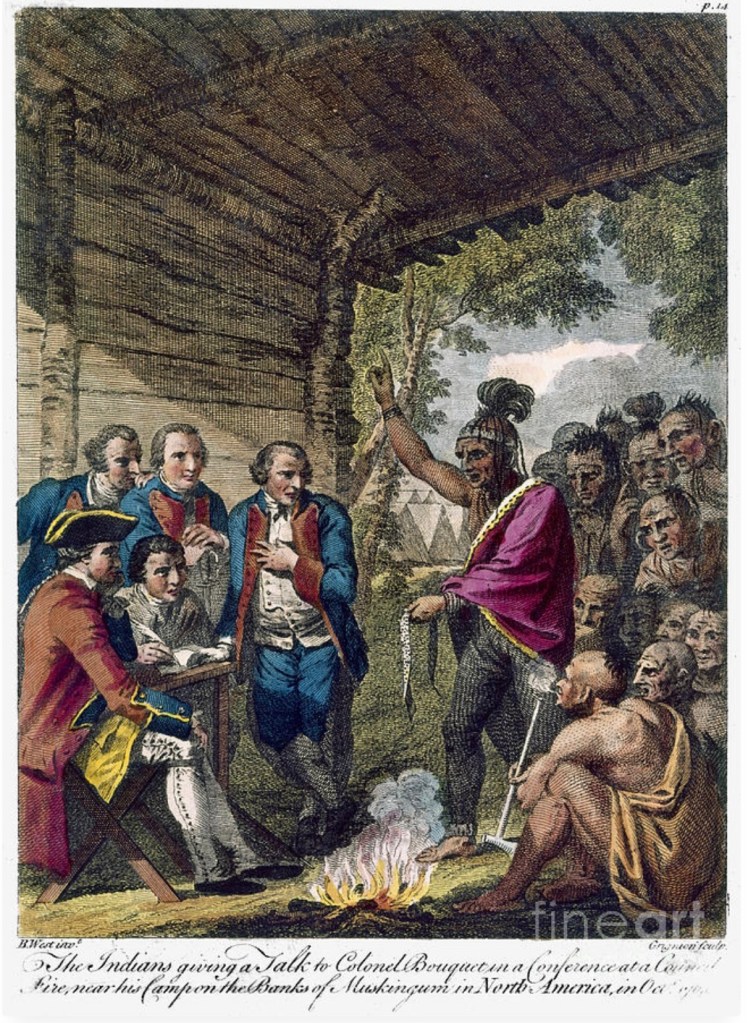
This type of situation and affection with the Lenape Indians played out precisely for Joseph, our ancestor. “It is related of Joseph, that although the Indians had murdered his Mother, brother and sister, and committed many other atrocities, he had become so attached to them and their customs and manner of living that he hesitated long before he decided to leave them and readopt civilization and live with the whites. The mutual attachment between him and his Indian brethren was such that it was kept long after his return. In due time he married… and settled down, but the habits he acquired during his long captivity never fully left him”. DJH, pg 45.
 The Ulrich/Baker Ancestral Lines
Leave a comment